


 Gosse Drent
First Light marks a new beginning for the world’s most famous secret agent. IO Interactive dares to return to the very first chapter of James Bond’s story, delivering a game that feels both familiar and surprisingly modern. After years of silence, this title not only explores the origins of 007 but also demonstrates just how relevant and vibrant Bond remains in 2026.
This review is spoiler-free.
A promise five years in the making
First Light was announced on November 19, 2020, under the working title Project 007. The world looked very different back then: we were still dealing with the aftermath of a pandemic, No Time to Die (2021) had finally arrived after multiple delays, and James Bond was still under the stewardship of EON Productions. It felt like a promising time for the franchise, which seemed ready to move again after a five-year hiatus.
Things turned out differently. Not only has major news regarding the next Bond film remained absent to this day, but IO Interactive also stayed remarkably quiet. They guarded the game as closely as MI6 itself would: no leaks, no screenshots, only the occasional update that development was progressing “steadily and according to plan.” In the end, it would take five years before we saw the first footage.
From the announcement onward, IOI made it clear that they intended to put their own spin on the Bond story while remaining faithful to the foundations laid by Ian Fleming and EON Productions. First Light even promised to go further back than Casino Royale (2006), telling what it called Bond’s “very first origin story.”
From stealth to a Kill
Partly due to the debacle known as 007 Legends, IO Interactive received a clear directive from EON Productions: “Bond is not a running machine gun.” Barbara Broccoli’s frustration with the Activision era became the foundation of IOI’s approach. To avoid repeating those mistakes, the studio developed a unique gameplay concept built around the most famous aspect of Bond’s profession: his Licence to Kill.
The escalation system works exceptionally well. Bond doesn’t immediately start shooting whenever he infiltrates a location, exactly as you would expect from a professional agent. The Licence to Kill mechanic naturally encourages stealth as the primary option. It works surprisingly well—and, more importantly, it’s a lot of fun. Thanks to the Q Lens, it’s easy to track enemy positions, while the multiple routes available in each level recall the very best of the Hitman franchise. The result is varied gameplay that allows you to approach missions however you prefer: eavesdropping on npc’s (non-playable characters), conducting investigations, using the environment to your advantage, or eliminating targets with gadgets. This is where First Light truly shines.
If you’re discovered, fighting is often the best option, as long as bullets haven’t started flying yet. Bond’s hand-to-hand combat feels fantastic: powerful, varied, and packed with satisfying weight behind every strike. Between combos, throws, and environmental takedowns, melee combat is better than it has ever been in a Bond game.
Prolonged escalation eventually leads to gunplay, and the game excels there as well. The animation of Bond smoothly picking up weapons, lifted straight out of No Time to Die, feels quintessentially Bond. Ammunition is scarce, forcing you to carefully consider every confrontation. Bond’s Instinct ability, a limited form of slow motion, helps level the playing field. IOI makes deliberate design choices that align with both Broccoli’s vision and the studio’s Hitman expertise, and the result works brilliantly.

The return of gadgets and vehicles
When fists and firearms aren’t enough, you can rely on your gadgets. They feel modern while still leaving room for classic elements from the older films. The Q Lens clearly indicates which gadget can be used in any given situation. Every gadget consumes resources—battery power for your watch, chemicals for other devices—meaning you can’t endlessly experiment without consequence. Run out of resources, and you’ll need to find another solution.
Fortunately, resources are easy to replenish if you pay attention to your surroundings. Early on, you’re limited to two gadgets and your watch, but later you’ll gain access to a third slot. The variety is impressive, although it’s easy to stick with a few personal favorites. The relationship between Q and Bond is also portrayed very effectively; Q quickly feels like a genuine friend, something this younger Bond desperately needs.
Vehicles also make their return. One minor disappointment is that they occasionally do a little too much for you. Modern cars may come equipped with lane assist and adaptive cruise control, but when I’m playing a game, I want to drive myself rather than feel guided every step of the way. It’s also a missed opportunity that Bond constantly switches between vehicles. As a result, you never really develop an attachment to a specific car, despite that being one of the strongest recurring elements in many Bond films and their most iconic vehicles.
Even so, the cars and boats are a welcome addition, and the sequences featuring them are impressively executed. There is certainly plenty to enjoy whenever Bond gets behind the wheel.

Vibrant environments packed with details
The level design is frequently outstanding. The game subtly nudges you in the right direction while fully embracing a sandbox structure. Environments are richly detailed, npc’s engage in lively conversations, and the world feels alive. There are also various collectibles to be found throughout the game world. These cannot be viewed in the main menu, but they can be found in the SimTac environment in the basement of Q Lab.
Find yourself somewhere you shouldn’t be and an NPC starts asking difficult questions? That’s when James’ inner Klaus Hergersheimer comes to the rescue. With minimal effort and a healthy dose of confidence, he effortlessly talks his way out of awkward situations, whether dealing with civilians or enemies. Bond always seems to have a clever quip ready for every encounter.
Each location has its own distinct atmosphere and offers multiple ways to complete objectives, greatly increasing replay value. Throughout the levels you’ll discover countless collectibles and references that Bond enthusiasts will adore. IOI has clearly watched the films and read the novels. The references don’t stop there, either, as there are numerous nods to other Bond media, including continuation authors and older games from previous publishers.

Who is this young Bond?
The 26-year-old Bond we play has already experienced a great deal, but he has not yet become the ruthless agent we know. He is fresh, optimistic, and still a work in progress. As the game progresses, we learn more about his past and gradually begin to recognize the man he will eventually become.
Patrick Gibson delivers an excellent young Bond. His voice may not sound traditionally Bond-like, but his interpretation feels believable. His expressions, posture, and attitude toward authority all feel exactly right. There’s a mischievous glint in his eye, and his chemistry with the rest of the cast works effortlessly.
At times, however, the script feels slightly off. Bond apparently has seen Reservoir Dogs (1992) and understands internet memes. That’s amusing enough, but other dialogue choices don’t always fit. Words like “mate” or “lads” feel distinctly un-Bond-like, even for a younger version of the character. Occasionally, he lacks that final touch of style and exclusivity that defines James Bond. Perhaps that reflects a world where every influencer and celebrity is expected to be relatable, but I still expect a little more class from 007.

Story: A Threat That Doesn’t Fully Land
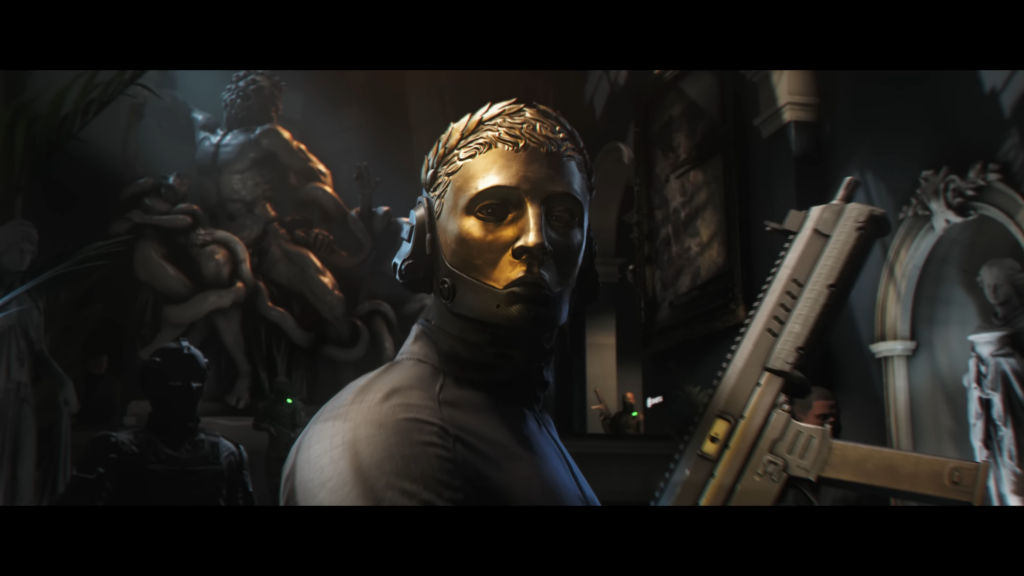
The marketing carefully avoided revealing who 009 is, who the man in the golden mask might be, or whether they’re even the same person. IOI focused primarily on Bond’s journey toward earning his 00 status rather than on the central threat itself. While Bond is portrayed strongly, the threat never feels quite as compelling.
Although the plot surrounding this threat is logically constructed, it never fully grabbed me. IOI studied the films so thoroughly that they unfortunately inherited some of their weaker and more familiar story beats as well. Many plot developments felt predictable or overly recognizable, reducing their impact. At times, the game feels like a rehash of storylines we’ve already seen too often—such as yet another rogue agent narrative, something familiar from both GoldenEye (1995) and Skyfall (2012).
One aspect is particularly well executed, however: the question of whether Bond will ultimately be betrayed by someone close to him. First Light creates an atmosphere where characters constantly walk the line between ethical and moral boundaries, and the cast sells that tension convincingly. Almost everyone ended up on my suspect list at one point, without any obvious clues pointing the way. The resulting sense of mystery kept me invested in the story even when the larger threat did not.
TacSim: Q Branch’s training ground
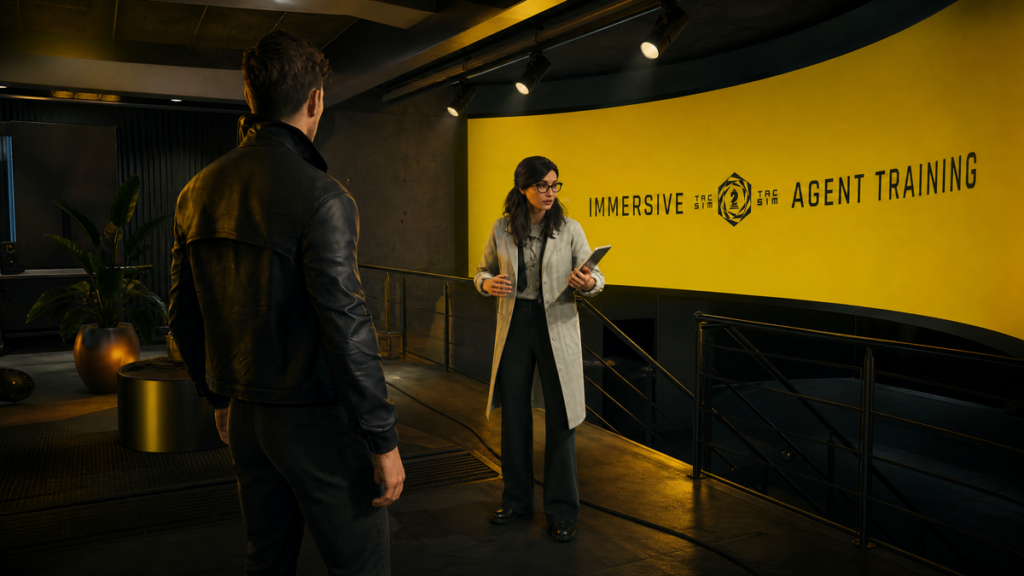
Players who aren’t interested in the story can head to Q’s TacSim, a training facility reminiscent of the VR sequence from Die Another Day (2002). Here, you can practice combat, gunplay, and various scenarios without narrative interruptions. Completing challenges unlocks outfits, gadgets, and upgrades.
It’s enjoyable, but not nearly as compelling as the story mode. That’s largely because outfits can only be used inside TacSim, despite the game’s marketing placing significant emphasis on them. It would have been far more appealing if players could switch outfits during the campaign, similar to From Russia with Love (2005). As it stands, part of the marketing feels like a false promise. I want to use my unlocked outfits, and especially the outfits some players paid extra for, whenever I choose.
Sure, it may not make much sense to stroll through a tropical paradise in a Royal Navy combat suit while sipping cocktails, but the gamer in me still craves that freedom. Because the marketing focused so heavily on outfits, it’s disappointing to see those options restricted in story mode. Particularly when that mode is considerably more enjoyable than TacSim itself.
The Foundation: Glacier Engine
First Light runs on IO Interactive’s proprietary Glacier engine, and its capabilities are on full display. I played on Xbox Series X, and every environment not only looks stunning but also loads quickly and smoothly.
Bugs are extremely rare, and the few I encountered were so minor that I quickly forgot about them. Luckily, the game is simply too enjoyable to dwell on such issues. The only time I became stuck was hardly a problem thanks to the generous checkpoint system, which ensures you’re never far from your most recent progress. The Glacier engine handles an enormous amount with apparent ease and, much like Bond himself, makes it look effortless.
Music and title sequence are a celebration of familiarity and flair
First Light clearly excels on a technical level. Equally important, however, is the music, which plays a huge role in shaping the atmosphere throughout the experience. The brass section hits hard and provides a constant sense of familiarity for Bond fans. Iconic riffs from the films regularly return, and when required, the score becomes gloriously bombastic. At its best, gameplay, action, and music come together in perfect harmony, bringing the action sequences to life.
It helps that the soundtrack doesn’t just sound cinematic; the title sequence itself demonstrates a clear appreciation for the work of EON Productions. The opening feels as though it could have been created by Daniel Kleinman himself and stands shoulder to shoulder with the title sequences from the Craig era. Even the way names appear onscreen (with the same Century Gothic font used in the films, complete with matching timing and animation) feels entirely authentic.
The visual style draws heavily on familiar Bond imagery, including Bond’s running silhouette. At the same time, the game establishes its own identity through a striking golden color palette and oversized chess pieces. In doing so, IOI may have delivered the most authentic Bond film experience ever brought to consoles.
Conclusion
FFirst Light is an extremely welcome addition, especially after the Bond drought of recent years. The game offers beautiful environments, strong level design, fluid gameplay, and excellent performance. Patrick Gibson delivers a convincing young Bond, while the world feels alive, detailed, and packed with references fans will appreciate.
Although the story occasionally stumbles and can be somewhat predictable, those shortcomings are more than compensated for by the game’s superb atmosphere, clever Licence to Kill mechanic, and the variety offered by stealth, combat, and gadgets. The Glacier engine also delivers an impressive technical showcase, with minimal bugs and fast loading times.
IO Interactive has brought a Gen Z James Bond into the 21st century and successfully prepared 007 for a new generation of fans without losing sight of the franchise’s rich history.
00 status for IO Interactive confirmed.
First Light is now available on Xbox Series X/S, PlayStation 5, and PC (Steam and Epic Games Store). A release date for Nintendo Switch 2 has not yet been announced.


 Hayco Volkers

Reageren